


Back in 2005, the more minimal side of electronic music was defined by Berlin. Richie Hawtin relocated his M_nus operations in Berlin. Perlon was releasing almost endless Ricardo Villallobos tracks. Stripped back grooves, closer to techno than house music, destined for endurance parties stretching till Sunday night. Minimal techno was living its Golden era in the mid 2000s.
About the same time, a new idea was taking shape in Paris’ undergrounds, an idea that proved to be as influential as it gets for the minimal and micro house music sound as we know it today. In 2004, Cabanne and neric (Eric Vence) set the stepping stones for Minibar, a record label that became home for artists like Rhadoo, Tom Ellis, Seuil, Audio Werner and many more. In 20 years of existence, Minibar released more than 70 EPs. I don’t know if it’s just our feel, but every single record from Minibar’s back catalogue share the same groove, regardless the producer or the release year.
An amazing performance given the economical context, the challenges of running an undeground label in the Spotify dominated era, the ever changing crowd, the social media boom.
Eric was open to tell us the story behind Minibar, a story that proves once again that the passion for good music is the main ingredient for keeping the electronic underground alive and kicking. So here it is, a raw unedited story about friendships, Paris, minimal house and pain au chocolates 👇
Do you remember how the Minibar project was born in the first place?
I was digging ambient, electronica and minimal techno in the late 90s, early 00s. I met Krikor on a geek message board in 2004. At the same time I wanted to throw a party with a few friends. As I knew he was friends with Cabanne, I asked him if they could play live. Cabanne was not available, he was playing in Japan. Krikor came over and the party was great. So we did a second one a few weeks later and this time with Cabanne and Krikor live. After meeting Cabanne that night and seeing each other a few times after that we were quite aligned on creating Minibar with one mission: release tracks we love on 12’. Which is still what we do today. I was also personally curious about 100% independent labels. The team includes Alex, a friend of mine, working back-office mainly on artwork.
What’s the story behind the Minibar name?
Cabannne played in Switzerland a few months before we decided to do the label together. He was staying there with Luciano and Sety from Circus Company. At one point in the DJ booth of Weetamix in Geneva Dimitri the owner told him in French “Y’a d’la minérale dans l’minibar” which translates to You can grab water in the small fridge
Don’t ask why, it was quite funny and “minibar” stayed as we were looking for a fun and short name that can be pronounced easily in many languages. And that was a match.
The motto is: Minibar is DJ’s best friend.
The Minibar logo was just created with Cabanne making a mistake playing around with line options in illustrator
Intriguing logo & minimalistic artworks to accompany the label’s sound. Who’s behind the visual side of Minibar?
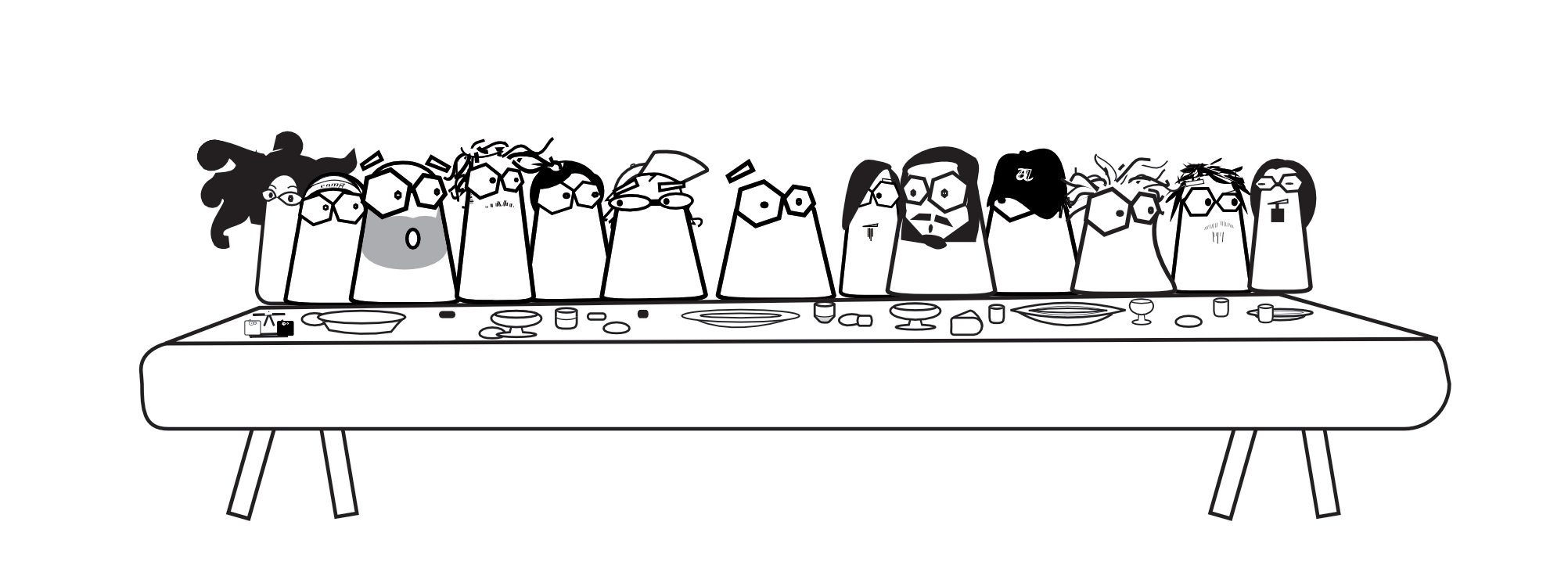
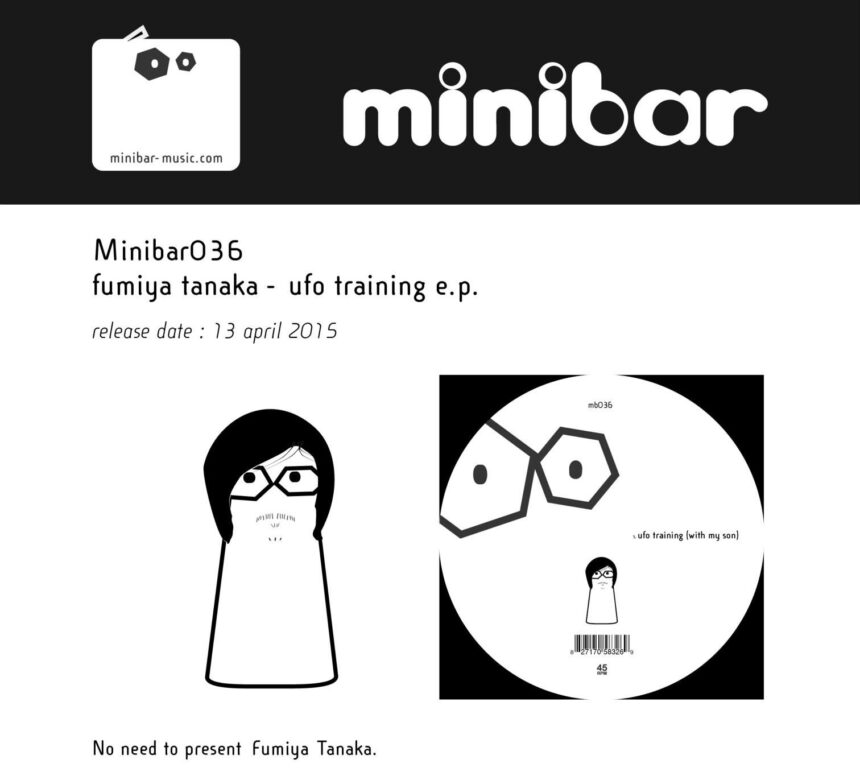
Originally, there are two main graphic components: the “minibarians” characters and the bubbly Minibar lettering. Everything is designed based on these graphic elements.
The characters came from Cabanne’s imagination – we had a series of test drawings that we really liked and the “logo” was just created with Cabanne making a mistake playing around with line options in illustrator… Using “convert into a rounded rectangle” gave us this timeless squared logo keeping the eyes and eyebrow in a unique and very graphic manner. We loved it.
We wanted to create a sense of closeness with the artist, but on the other hand, we didn’t want to highlight them in a conventional way with a cliché photo. Personifying them through a cartoonish character allows them to enter a different social and musical universe – one that’s outside of a context where everyone’s just gazing at their own navel. I think artists appreciate having their own “minibarian” character. It ties them to the label’s story and connects them to a group of musicians and friends who really don’t take themselves too seriously.
One might say that Minibar is minimal techno & micro house in its purest form. After 20 years, is this still true?
It’s not the artist’s style or artistic direction that dictates our release choices. To keep it fun, we really go with what we enjoy: playing, listening to, and dancing to. And maybe that’s why there’s been a certain consistency over the past 20 years. I don’t know if you’d call it purist, that’s not really how we approach it.
We also find it interesting that a minimal techno or micro house release can find a home on a label that continues to support and promote those kinds of musical atmospheres. And good music ages well – as long as we consider it to be good music, haha.
That said, there are a ton of styles we enjoy. We’ve been tempted to branch out into other genres, maybe with a sub-label, but that would take us away from our original concept.
Define the Minibar sound in 3 words.
Groove, minimal, intricate.
Diving into Minibar’s back catalog, there are a lot of French artists, from Cabanne to Lowris, Pit Spector or Point G. Is it a French affair after all?
It’s probably a French affair when we work with artists who are close to us, in France. And there’s a fertile ground of talented people in France, probably like elsewhere.
However, it’s not only French artists — we receive demos from all over the world and we work with artists we love like Agnès (Switzerland), Your Mad Friend (Poland), Audio Werner (De), Jeff Samuel (USA), Fumiya Tanaka (Japan), Tom Ellis (UK), Martinez (Denmark), Rhadoo (Romania), Denis Kaznacheev (Ru, De), Max Jacobson, (USA), Snad (USA)…
It really depends on the context and the randomness of demos, because working with French artists isn’t a deliberate policy on our part
A&R for Minibar: open for receiving demos or working with a few carefully chosen producers, in a closed circuit manner?
We’re definitely open and we receive a lot of demos.
That said, we don’t release very often, so we’re not actively seeking new material just for the sake of it. The landscape has also changed – distribution is different now, and releases can easily get lost in the noise. The music ecosystem we operate in shapes our choices too, from pressing schedules to musical direction. We’re navigating all of that as it evolves. Ultimately, we’re guided more by what excites us and resonates personally than by any pressure to constantly produce. It’s a balance, our own yin and yang.
Close to 20 years of activity, with 50+ releases. How are the record label’s duties split between you and Cabanne?
A big part of the work is done together – because we genuinely enjoy it. Then we divide tasks based on our skillset: Cabanne is more in touch with the artists, while I handle the organizational and administrative side. Our friend Alex helps us with graphic design. Over time, the process has become pretty smooth: we know what needs to be done at each stage, from discovering music to distributing it. What matters most is staying motivated together, and we keep each other inspired.
How does the underground scene in Paris look like, compared to how it was back in 2005, when you launched the record label?
The scene has had its ups and downs, but today Paris is once again a city with a high density of activity; much more so than in 2005. The scene is strong, even if it doesn’t fully align with the sound we push – and that’s totally fine. It’s actually very healthy, especially compared to some of the places Cabanne travels to and that we get to discover along the way.
The underground has changed radically, but it’s vibrant. It’s not centered on minimal house anymore, but there’s no sense of disrespect for it either, which is great. You’ll find classic house, trashy and fat, as well as older or very fresh techno. There’s a broad spectrum, and a lot of great venues – way better than before. Also promoters seem to behave better than the average 20 years ago. That’s really satisfying.
The only real challenge is that it’s easy to get lost in it all. It’s quite complex to read through lineups, even though some do a good job at offering clear and consistent music propositions. In any case a barren scene would be far worse and way less inspiring.
It seems like the French house scene is living a revival in the past years. Do you feel the same?
I wouldn’t call it a revival, but more of a rebirth and a diversification. The past is a foundation and it gives energy and meaning to the current scene, which is evolving with its own codes. That’s maybe what art is about: appropriation and evolution, drawing from inspirations, using new tools. It’s all part of a continuum.
We can easily agree that there’s more options than before to listen to French house music.
Given the cultural impact of electronic music on the youth, is there any support from the government?
If you really look around, France is a country of culture. Even if the underground scene had a bad reputation 30 years ago, it’s now recognized as part of the broader cultural landscape. The French love to complain, but honestly, we’re in a fairly supportive environment. There are subsidies available, parties are now officially accepted, there are new fantastic spots all over the country and that’s a good thing. This could never happen if the government was totally restrictive.
That said, when it comes to electronic music events, there can still be friction with local authorities. These issues can be painful and unfair and must be fixed. Apart from that some people will always complain, and that’s probably never going to change – but overall, the situation is quite positive.
Owning an electronic music record label: does it have the slightest profit margin or is it just for the love of house music?
You bet, it’s all for the love of house. To break even, we’d have to sell more records, more often, and cut costs across the board. But doing that would go against our values and our mission. We’d end up chasing numbers instead of quality tracks. That makes sense in a private business, but it’s destructive in an artistic project.
Sure, Minibar exists through a company structure because it has to. But that’s not the point. It’s just a tool, a necessary step to press music onto vinyl. We’re incredibly lucky to be able to keep doing this, and somehow, we always find a way to absorb the losses. That’s part of the deal.
Keeping this label alive and kicking after 20 years is already something we’re proud of.
In a world where instant gratification and social media mirrors are invading the underground, is there still a place for a vinyl record label in the undergrounds?
More than ever vinyl is making a strong comeback. But it does come with real challenges for independent labels, especially when it comes to production costs (too high), production planning (boring, pop music gets priority nowadays) and retail pricing (we find it too high).
Plus, to stay financially viable, there’s often pressure to make easier choices in terms of sound, or to streamline everything from partnerships to manufacturing. Scalability in art is tricky. There used to be 1,000 tracks, now there are 100,000. There used to be 1,000 music labels, now there are 10,000. To make it work, you’d need to sell around 1,500 copies per release and put out 8 to 10 records a year, which is absolutely not possible. The consequence for Minibar is that, as a super-independent and niche label, we don’t have the strength and the level of support we’d like to execute a vinyl roadmap exactly how we imagine it. But that’s always been part of the game. We accept it, and we find our way through it.
That being said, there’s a place for vinyl, there’s a place for record labels. But you gotta be pragmatic enough and don’t consider it as a profitable business.
Lively music on a lively medium, played by lively people, will never go out of style.
A few Point G classics stuffed on one single release was a golden, at least for me. What’s stopping you for doing these kind of reissues / represses from time to time?
That Point G release was a one-off opportunity – it happened naturally between Cabanne and Grégory. They discussed that in a cab back from the airport. There’s nothing really stopping us from doing more, but it’s not our main objective and we don’t have so many opportunities!
We tend to seize opportunities as they arise, rather than strictly following planned strategies, as long as they align with our values and mission. Plus, we keep receiving amazing demos that deserve to exist as fresh, new releases. So our focus stays on the present and the unexpected.
Cabanne’s Discopathy or Tom Ellis’ The Color Red, two amazing LPs that go way beyond the minimal house sound we’re used with at Minibar. Should we expect more stuff like this in the future?
That’s actually one of the artistic directions we’ve always wanted to explore with the label. It’s really exciting to broaden the spectrum and tell deeper, more complete musical stories. It goes beyond just groove.
We don’t release that kind of record very often, but when we do, we’re always super proud and enthusiastic about it. So yes, there will definitely be more.
Miradolores: the perfect definition for the Minibar sound, yet with a totally unexpected name (Rhadoo) behind the EP. How did this happen?
This was again an opportunity, though a bit more expected than the Point G release. Cabanne and Rhadoo are really good friends and it all came down to timing. Things just aligned naturally, without overthinking it.
That EP probably sparked even more initiatives between them, whether it’s behind the decks or working together on some remixes or as “Cabsum”.
The collaboration between Rhadoo and Minibar might come as a surprise, but it actually makes a lot of sense. We felt the connection a long time ago, listening to Cabanne and Rhadoo play together in a club.
A clubhead Paris city break: pick up one record shop, one small venue for a nice electronic music weekend and one breakfast spot in Paris.
Sounds like a plan!
Dig at Yoyaku
Yoyaku is a mind blowing entrepreneurship. Benjamin, running the business, is ambitious for a purpose we all share. He understood straight away that running any of the chain links will not be profitable enough to develop the business and pay the artists. So he needed to work on a virtuous ecosystem serving his company and the artists. He tried, he succeeded and failed on different topics and in the end he built something great: a shop, an artistic environment, great parties, quality distribution, mutualised production means, eclectic music labels, cool goodies… and a very nice team of experts.
Swing at Essaim
Essaim is shaping up to be one of the better clubs in Paris. It offers a mind-blowing experience shared between the crowd and the artists. The lineups are thoughtfully curated, and the venue itself is impressive. The booth fits naturally into the environment, the sound is powerful and crystal clear. The project is run by the team behind Concrete, which signals a strong and ambitious future.
To eat breakfast, spot a 4.5+ stars Boulangerie on Maps.
Grab a baguette tradition along with your favorite viennoiserie. Cabanne and I would kill for a proper pain au chocolat. Back when we used to throw Minibar parties in Paris and host foreign artists, picking up viennoiseries was part of the ritual. 😋